
Pulling the Thread: How Everything That’s Overwhelming Us Right Now is Connected
From bombed oil fields to your grocery data to a cringe-worthy singing MP in Canberra - the single logic behind our most alarming news stories, and why seeing it clearly is the first act of resistance

A note before we begin: As many of you know, I am not a geopolitical strategist, an economist, a diplomat, or an international lawyer. I am a business strategist, a community organiser, a citizen, and a relentlessly curious person who reads widely and refuses to look away. Better minds than mine - Yanis Varoufakis, Shoshana Zuboff, Naomi Klein, Kate Raworth and others - have mapped parts of this terrain, and I will point you toward their work throughout. What I offer here is a pit stop, not a destination: a place to gather our thoughts, find the pattern, and orient ourselves before we go deeper.
What do a US-Israeli airstrike on Iran, a farmer who cannot fix their own tractor, your Netflix subscription, a singing stunt in federal parliament, and the reason I stopped using ChatGPT have in common?
More than you think. They are expressions of exactly the same logic - operating at different scales but pulling from the same playbook.
We are living through what feels like an avalanche of disconnected crises.
That feeling of disconnection - the overwhelm, the sense that the world is simply falling apart in random ways - is not accidental.
When we cannot see the pattern, we cannot resist it.
When we cannot pull the thread, the enclosure continues.
So let us pull the thread.
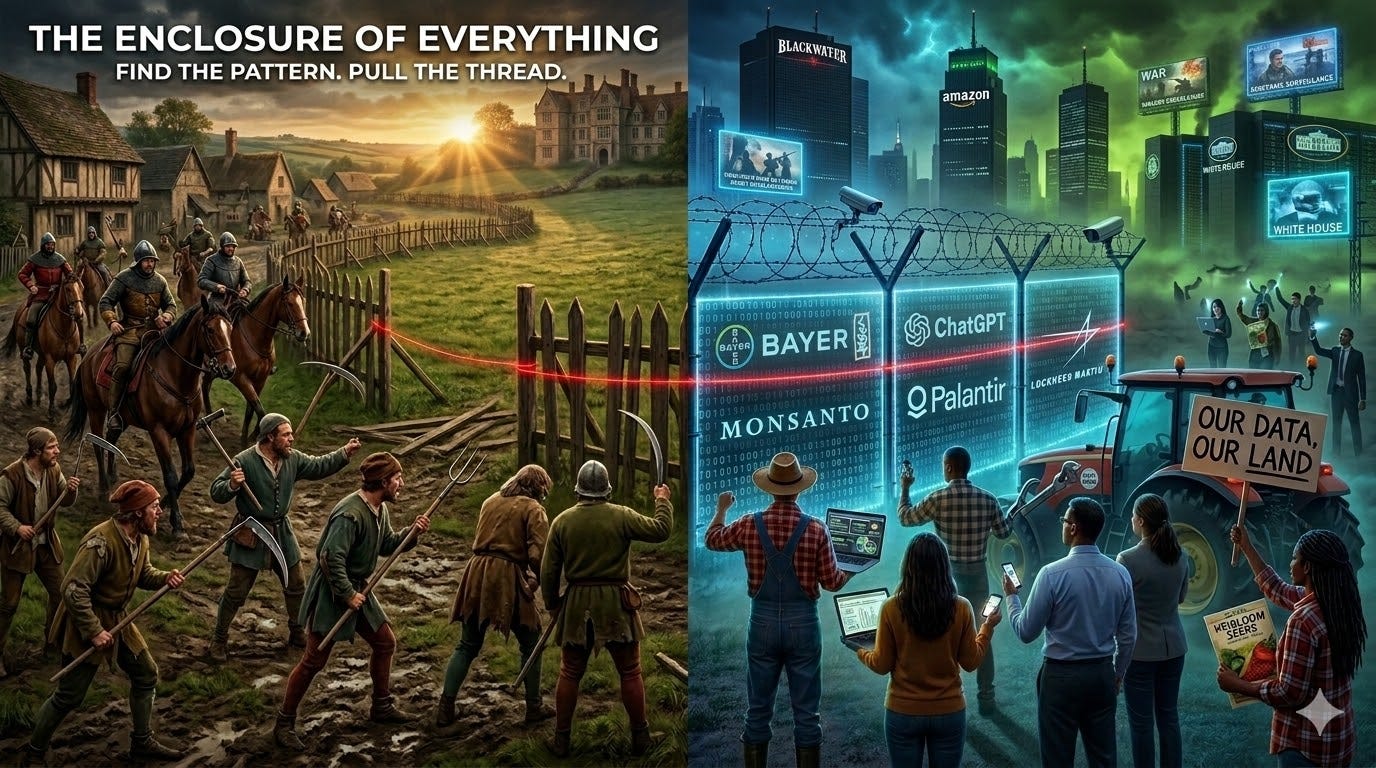
Everything in this article - from bombed oil fields to your grocery app to a cringe-worthy singing MP in Canberra - is a chapter in the same story: the Enclosure of the Commons, updated for the 21st century. Once you see it, you cannot unsee it.
1. The Enclosure of Everything
There is an old concept in economic history called the Enclosure of the Commons. From the 15th century onward, the common lands of England - where ordinary people grew food, grazed animals, and sustained their livelihoods - were systematically fenced off by wealthy landowners and the state. The people became tenants, then labourers, then dependents.
We are living through Enclosure 2.0.
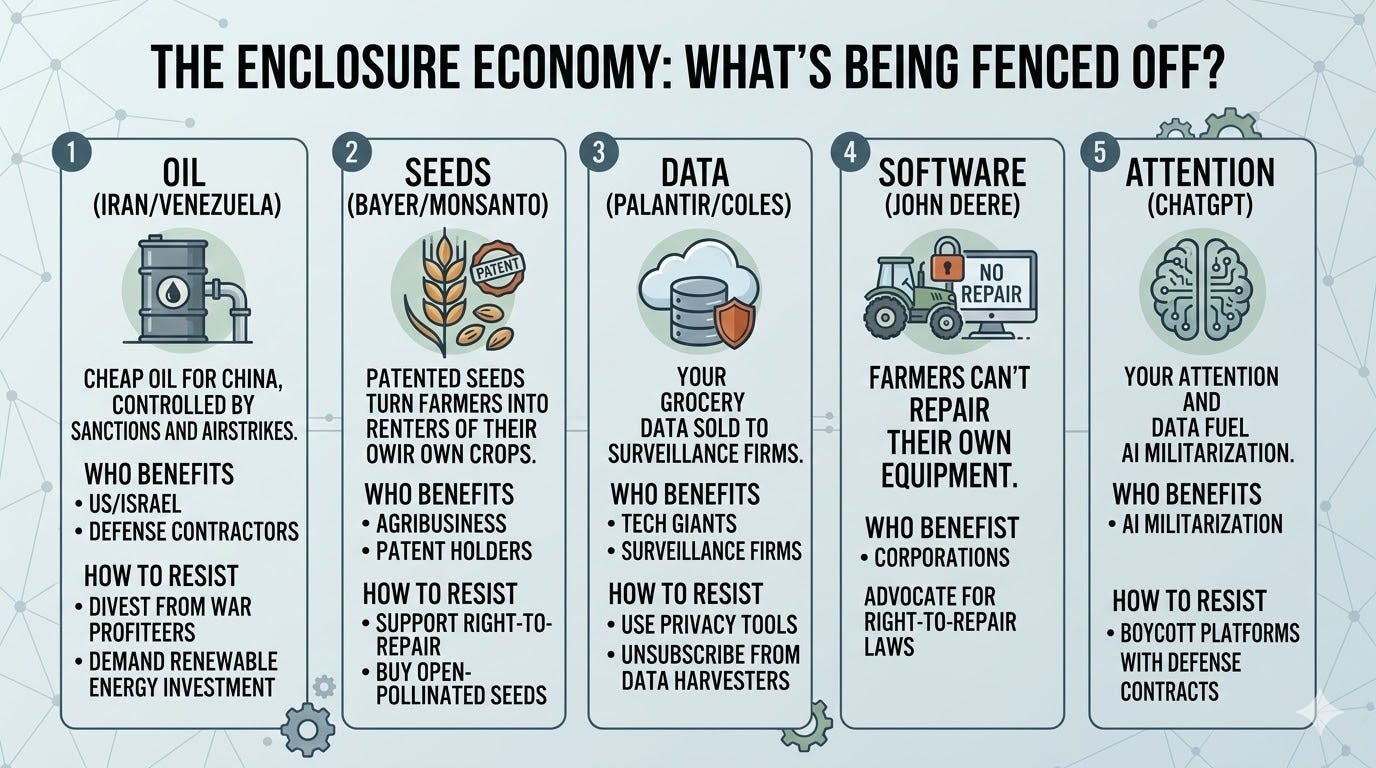
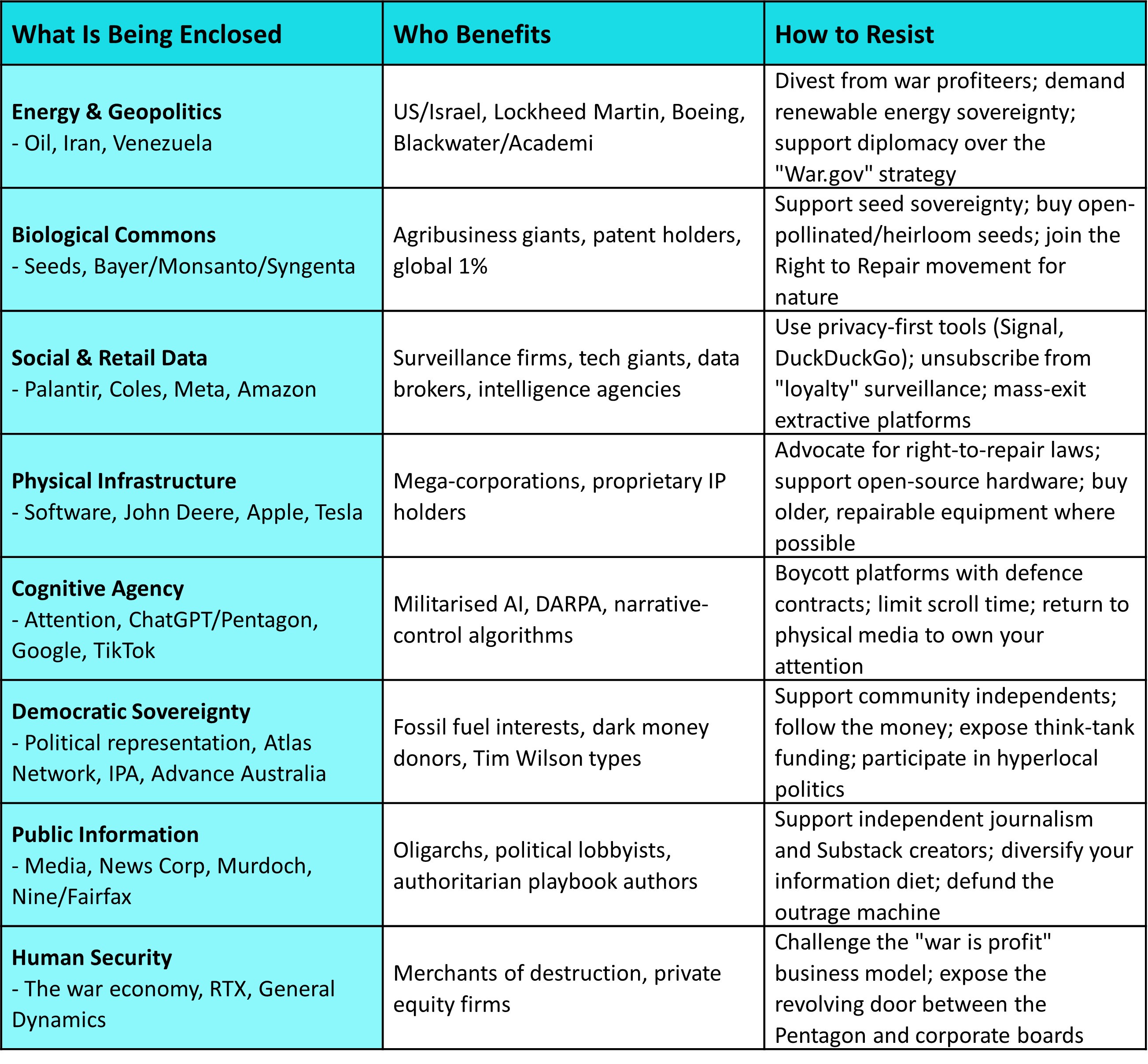
The commons being fenced off today are not just fields - they are oil reserves, seeds, software, data, political representation, and our attention itself. The method is identical: transfer ownership, agency, and power from the many to the few.
What has changed is the scale, the speed, and the sophistication of the justifications offered.
2. The Global Chessboard: Iran, Venezuela, and the Real Target
On 28 February 2026, the United States and Israel launched Operation Epic Fury against Iran, killing Supreme Leader Khamenei and dozens of senior military figures. The official framing was nuclear deterrence. The strategic logic runs much deeper.
China purchases around 90 percent of Iran’s oil exports - a critical lifeline for Beijing’s strategic energy reserves, as confirmed by the Columbia Centre on Global Energy Policy.² Venezuela, another Chinese ally, was targeted in January 2025 with the capture of Maduro. Both operations targeted nations supplying China with discounted, sanctions-protected energy. Zineb Riboua of the Hudson Institute is direct: “Remove the Islamic Republic from the equation, and China loses its pawns for a Taiwan contingency. Trump’s strikes are the first move by an American president who appears to understand that the road to the Pacific runs through Tehran.”¹ Economist Madi Kapparov puts it plainly: “The objective is to choke out the primary source of cheap oil to China.“³
This is a 21st-century Monroe Doctrine - enforced not with political speeches but with B-2 bombers.
The human cost - Iranian civilians, regional stability, the shattered prospect of a negotiated settlement - is largely invisible in the strategic calculations of the people making these decisions. That invisibility is not accidental.
Counterargument you will hear:
“But the US is just securing Taiwan and defending the free world.”
The harder question:
If stability were the goal, why escalate simultaneously across multiple fronts - Iran, Venezuela, tariffs, the Department of War renaming - leaving no space for diplomacy to breathe? The pattern looks less like defence and more like deliberate enclosure of the global energy commons.
3. Why Nobody Stops Them: The Mechanics of Impotence
The question pulsing through every serious conversation right now: why are world leaders so impotent? Why does nobody stop them?
The impotence operates through three interlocking mechanisms.
Structural dependency.
Most nations are economically or security-dependent on the US in ways that make open defiance genuinely costly. Australia is embedded in AUKUS, Five Eyes, and Pine Gap. We are not neutral observers. We are participants.
Manufactured chaos.
Naomi Klein’s Shock Doctrine identified this precisely: when you move fast enough on enough fronts simultaneously, organised opposition never consolidates. By the time the world responds to Iran, there are three new crises. The avalanche of outrages is a governance technique, not a side effect.
Leverage.
In November 2025, Congress passed the Epstein Files Transparency Act - forcing Trump to sign it after he had reneged on his campaign promise to release the files, with his DOJ claiming no evidence of blackmail existed.⁴ The releases now total over three million pages documenting Epstein’s extraordinary network across politics, royalty, business, and intelligence-connected figures on multiple continents. What the files document, beyond the appalling crimes, is a system: homes equipped with recording technology, connections to FSB-linked Russian figures, patterns consistent with kompromat operations.⁵ The Middle East Monitor notes: “In negotiations over arms sales, trade agreements, or diplomatic recognition, the ability to silence or sway decision-makers is invaluable.”⁶
I cannot draw definitive conclusions. Neither can you. But we can observe the pattern - and ask why those in power move so quickly to close the conversation down. The files are publicly browsable at justice.gov/epstein.
4. The Department of War, Fascism, and the Enclosure of Democracy
In the late 1940s, the United States renamed its Department of War the Department of Defense. The timing was deliberate: after two world wars, the optics of running a permanent “War Department” were uncomfortable.
So they changed the sign. They did not change the business model.
The US has been at war, funding war, supplying war, or engineering the conditions for war in virtually every decade since. Lockheed Martin, RTX, Boeing, General Dynamics, Blackwater/Academi have never had a bad year because of war. That is not a side effect. That is the business model. Lockheed Martin’s CEO told investors in 2023 that the conflicts in Gaza and Ukraine would “drive revenue for years.” Private equity firms cycle through defence contracts the way they cycle through any other asset class: extracting returns, externalising costs, and moving on.
Now Trump has stripped away the fig leaf.
In September 2025, he signed Executive Order 14347 - making “Department of War” the official secondary title, switching the Pentagon’s URL to war.gov.⁷ “It sends a message of victory,” he said. Pete Hegseth called it restoring a “warrior ethos.” They are not wrong that it is honest. That is precisely what makes it chilling. For 75 years, “Defence” was the polite fiction that let us look away. Now they are telling us plainly what they are, what they do, and who profits. There is nowhere left to hide.
And this - the dropping of the fig leaf, the open declaration of intent - is exactly the context in which Yanis Varoufakis becomes essential. In his recent ABC Late Night Live appearance on Iran, he described fascism not as a single dramatic coup but as a gradual 4-step process:
the merging of corporate power and state power
the dismantling of independent institutions
the cultivation of scapegoats to distract from structural theft, and
the slow normalisation of the previously unacceptable.⁸
You do not wake up one morning in a fascist state.
You drift there - incrementally, deliberately - while the guardrails are removed one by one, and the people who might have stopped it are mocked, defunded, or bought.
The Department of War is not an aberration. It is a destination.
It is what the system looks like when it stops pretending.
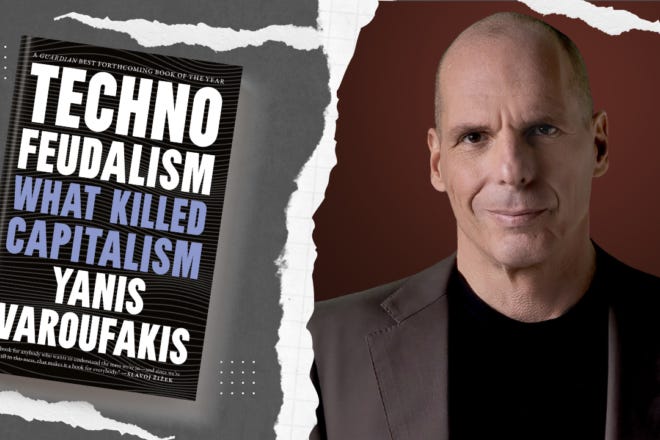
His book Technofeudalism extends this argument: we have moved beyond capitalism into something new - a system where big tech platforms function as feudal lords, extracting tribute (our data, our attention, our labour) while we believe ourselves to be free participants in a market. The “cloudalists” do not compete in markets. They own the clouds through which all markets must pass.
Look at what is around you:
News Corp controlling roughly 60 percent of Australian metropolitan print circulation; Nine Entertainment absorbing Fairfax; the systematic defunding of public broadcasting; economic policy captured by think tanks funded by fossil fuel interests; OpenAI signing contracts with the Pentagon; Palantir embedded in your supermarket.
The enclosure of public information is not a side issue - it is the mechanism that makes all the other enclosures invisible. When the media landscape is owned by the same interests that benefit from the enclosure, the enclosure becomes very difficult to see, let alone resist.
This is not a warning about the future. This is a description of the present.
5. The Corporate-Tech Complex: You Are the Product
This week I wrote about why I stopped using ChatGPT after OpenAI entered defence contracts with the Pentagon. I am not alone - the response was immediate and measurable. According to market intelligence firm Sensor Tower, ChatGPT saw a 295 percent spike in uninstalls on 28 February alone. One-star reviews surged 775 percent in a single day. The QuitGPT movement reports 2.5 million people have pledged to cancel or switch. Claude overtook ChatGPT as the top AI app on the US App Store within the same weekend. Sam Altman later admitted the deal “looked opportunistic and sloppy.”⁹
I explained it this way in a radio interview this week:
“Think of it this way: ChatGPT is a car. Every prompt you type - your questions, your business ideas, your creative work - that’s the fuel. That fuel makes the engine smarter. It learns from all of us. Now that same engine has been wired into the Pentagon. The car is being used to transport military cargo, carry bombs that level civilian infrastructure, and conduct mass surveillance of our every move. You have been putting the fuel in. You did not sign up for where that car is now driving. So some of us are returning the keys.”
When a tool crosses into the war machine, using it is no longer neutral.
Harvard Professor Shoshana Zuboff calls what these platforms do “the expropriation of critical human rights“ - treating human experience as free raw material for extraction and profit, without consent and without return.¹⁰ The Coles-Palantir partnership applies this logic to your weekly groceries. John Deere’s software locks prevent farmers from repairing equipment they purchased outright.¹¹ Bayer’s seed patents prevent farmers from saving their own crops.¹² The farmer who cannot fix their tractor and the professional whose work trains a war machine’s AI are caught in the same trap: converted from owners into tributaries. The drift back to CDs is not nostalgia - it is people reclaiming ownership, one small act at a time.¹³
6. The Local Franchise: Tim Wilson and the Atlas Network Playbook
Tim Wilson is not an accident of Australian politics. He is an investment. His career runs from the Institute of Public Affairs - founded with grants from Santos, Shell, BHP, and Rio Tinto - through Atlas Network recognition, through a $1.58 million Advance Australia proxy campaign in Goldstein, to his appointment as shadow treasurer.¹⁴ Every step bankrolled by the same network. Every step in service of the same interests.
Even Pauline Hanson called him “cringe.” That is quite a bar to fail.
Wilson is a symptom, not the disease. The Atlas Network - a global web of libertarian think tanks - runs the same play in every jurisdiction: defund public services, eliminate regulation, privatise the commons, and ensure the people writing economic policy are the people who benefit from it.¹⁵
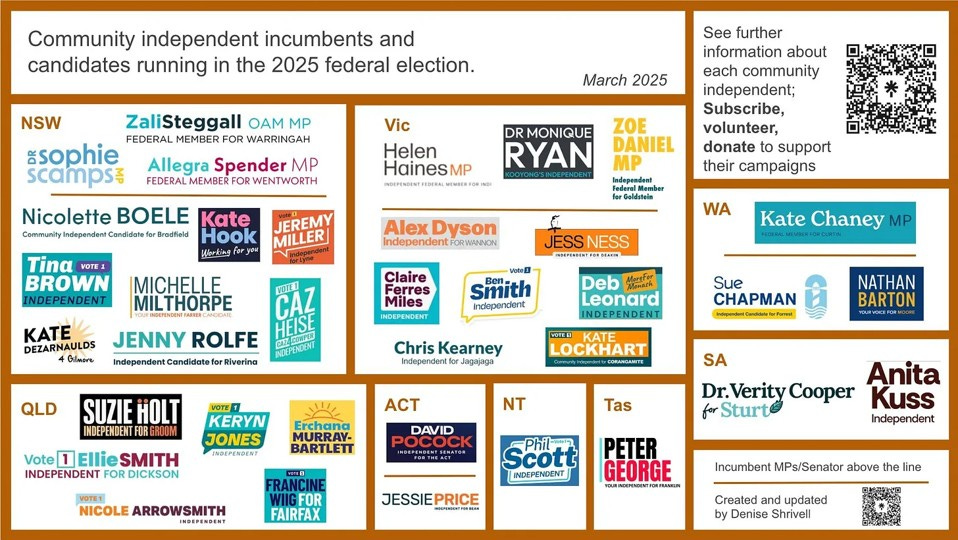
It is the political arm of the same enclosure logic operating in the oil fields of Iran, on John Deere’s servers, and in Palantir’s data centres. This is why the fight for community independents - in Goldstein, in Farrer, everywhere the machine is being contested - is not a local skirmish. It is a front line in the Great Reclamation.
7. Where to Pull: Your Patch in the Quilt
You do not need to do all of this. You need to find your patch - and start there.
Mass unsubscription works.
The ChatGPT exodus proved it: 2.5 million pledges, a 295 percent uninstall spike in a single day. Subscription revenue is immediately sensitive to collective exit. When enough people move together, it registers where it hurts.
Ownership is resistance.
Buy the CD. Save the seed. Use open-source tools. Bank with a credit union. Support right-to-repair legislation. Every act of reclaiming ownership is a withdrawal from the enclosure economy — individually symbolic, collectively structural.
Follow the money, always.
Every time a politician, policy, or product appears: who funds this? The Atlas Network, the IPA, Advance Australia, Palantir - these are specific organisations with specific funders and specific agendas. Naming them is not conspiracy. It is accountability journalism.
Show up locally.
The global playbook runs through local franchises and local franchises can be beaten. Attend your council. Volunteer for a community independent. Vote with full information at every level. Hyperlocal democracy is the last line of genuine defence.
A Final Thought: The Commons Can Be Reclaimed
Let us return to where we began: the Enclosure of the Commons.
The original enclosures took centuries to complete and they were never total.
People resisted. They built new commons: trade unions, public libraries, universal healthcare, the ABC, community land trusts, open-source software, community independent movements.
Every generation that faced enclosure eventually found a way to reclaim what had been taken - not all of it, not easily, not without cost, but enough to shift the balance.
That is the historical truth the enclosers do not want you to sit with. Enclosure is not inevitable. It is not permanent. It depends - entirely - on the belief that resistance is futile.
The ChatGPT exodus reclaimed cognitive sovereignty - 2.5 million people in a week.
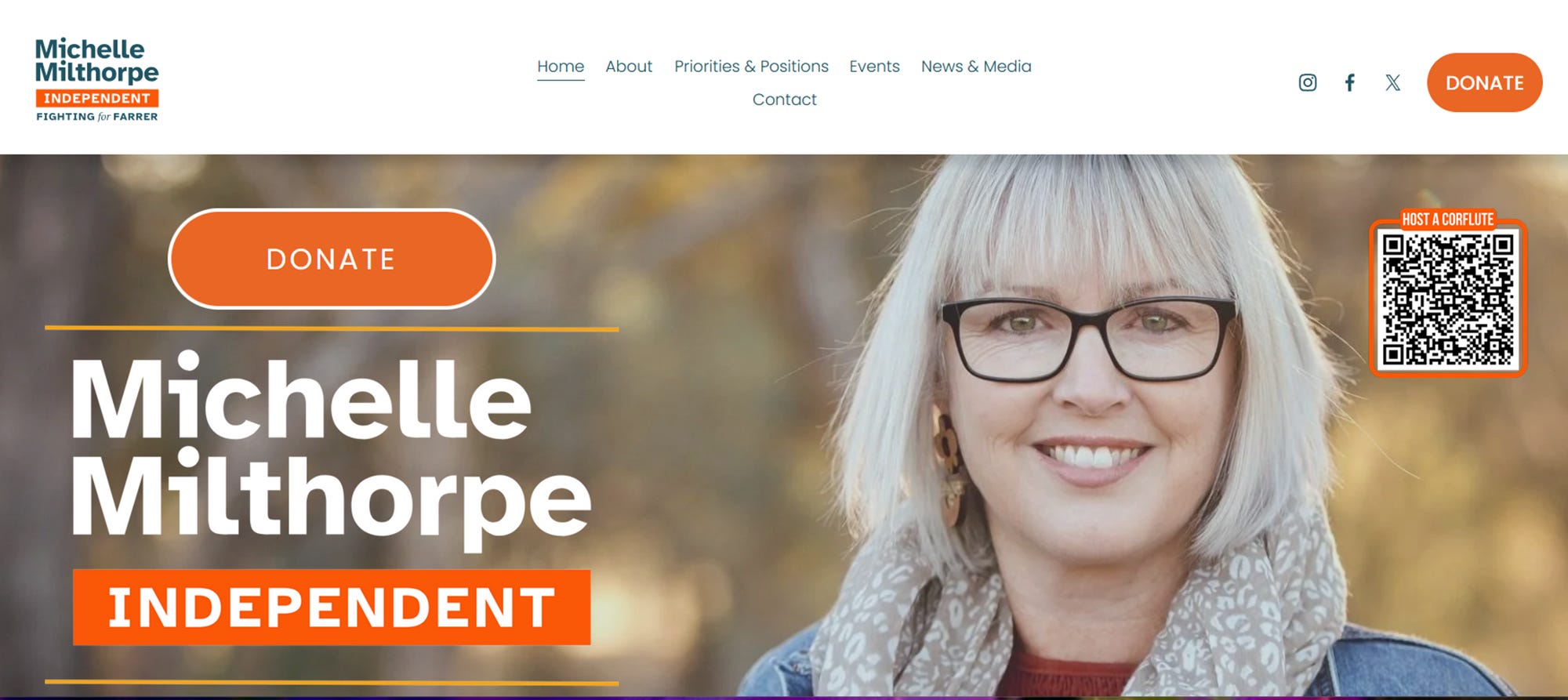
Community Independents reclaimed democratic sovereignty in 2013, 2019, 2022, and 2025, and maybe they can do it in Farrer by-election in 2026 by voting in Michelle Mithorpe.
The right-to-repair movement is reclaiming physical infrastructure, field by field, tractor by tractor.
The drift back to CDs is reclaiming cultural ownership, one album at a time.
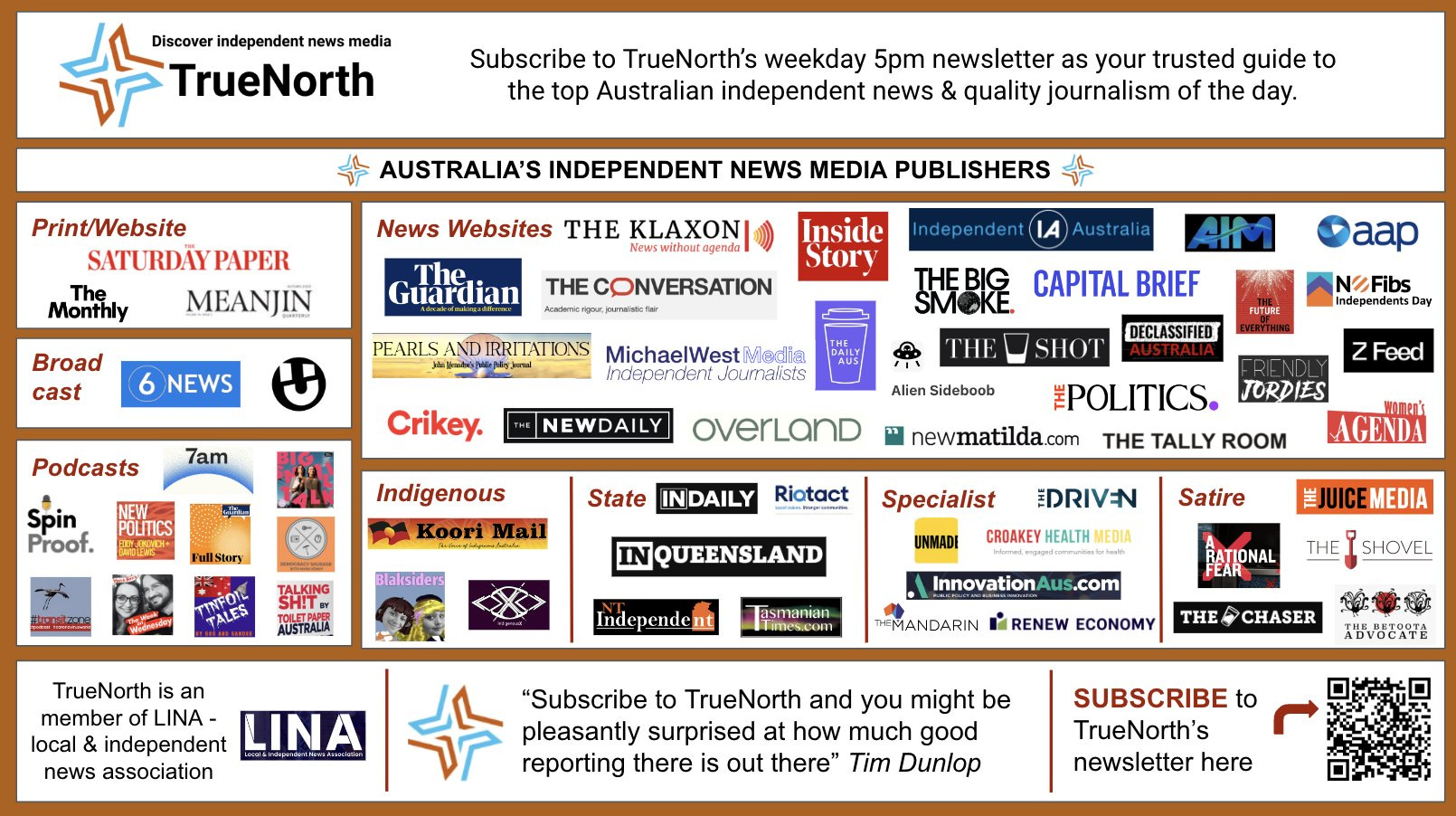
The Substack you are reading right now exists because people reclaimed their information commons when the mainstream media failed them.
None of these are small. Together, they are a pattern - a counter-enclosure, building quietly at every scale simultaneously.
The enclosure depends on our passivity, our atomisation, and our overwhelm. A confused, exhausted, divided population is a manageable population. So clarity, connection, and organised action are precisely the things it cannot absorb.
This article is an attempt at the diagnosis. The next one is the blueprint: what the Great Reclamation looks like in practice - in your business, your community, your politics, and your daily life. Because the commons were built before. They can be built again. And the tools, the models, and the people to do it already exist.
The thread runs through everything. Once you can see it, you cannot unsee it. And once you cannot unsee it, you start to see where to pull.
Find your patch. Pull the thread. Start the conversation.
The Great Reclamation starts here.
You know what to do.
Onward we press
References
Zineb Riboua, The Iran Question Is All About China, Hudson Institute, March 2026: hudson.org
Columbia Centre on Global Energy Policy, US-Israeli Attacks on Iran and Global Energy Impacts, March 2026: energypolicy.columbia.edu
Madi Kapparov, quoted in Trump’s Iran Strike Is a Bigger Play That Also Cuts at China, Newsweek, March 2026
Wikipedia, Epstein Files, updated March 2026; PBS NewsHour, 7 Things to Know About the DOJ’s Epstein Files, November 2025: pbs.org
Euronews/The Cube, Do the Epstein Files Show He Was Working for Russia?, March 2026: euronews.com
Middle East Monitor, The Epstein Files: Blackmail, Power, and Geopolitical Shadows, February 2026: middleeastmonitor.com
Wikipedia, Executive Order 14347, September 2025; NPR, September 2025: npr.org
Yanis Varoufakis, ABC Late Night Live, March 2026: abc.net.au/listen/programs/latenightlive/yanis-varoufakis-iran-war/106421524
Sensor Tower data via eWeek, March 2026: eweek.com; QuitGPT: quitgpt.org; CNBC, Altman Admits Deal “Looked Opportunistic and Sloppy”, March 2026: cnbc.com
Shoshana Zuboff, The Age of Surveillance Capitalism (PublicAffairs, 2019); Sue Barrett, When Your Groceries Become Surveillance: suebarrett.substack.com/p/when-your-groceries-become-surveillance
Wired/Motherboard, ongoing John Deere right-to-repair coverage; repairaustralia.org.au
ETC Group, Seed Atlas 2023: etcgroup.org
BBC, Why Young People Are Buying CDs Again, 2025
Sue Barrett, Tim Wilson: Product Placement, Not Public Servant: suebarrett.substack.com/p/tim-wilson-product-placement-not
Investigate Europe, The Atlas Network, 2021: investigate-europe.eu
Dig Deeper
Iran, China, and great power competition: Hudson Institute: hudson.org · Columbia Energy Policy: energypolicy.columbia.edu · National Interest, March 2026: nationalinterest.org
War economy and fascism: Yanis Varoufakis, Technofeudalism (2023) · Naomi Klein, The Shock Doctrine (2007) · Sue Barrett, The Merchants of Destruction: suebarrett.substack.com
Epstein and leverage: DOJ Epstein Library: justice.gov/epstein · Euronews/The Cube: euronews.com · Middle East Monitor: middleeastmonitor.com
Surveillance capitalism: Shoshana Zuboff, The Age of Surveillance Capitalism (2019) · Sue Barrett, The New Pricing Scam and Decoding Peter Thiel: suebarrett.substack.com · Cory Doctorow on enshittification: pluralistic.net
Ownership, repair, seeds: repairaustralia.org.au · etcgroup.org
Media and independent journalism: The Saturday Paper: thesaturdaypaper.com.au · Michael West Media: michaelwest.com.au · Crikey: crikey.com.au
Think tanks and local politics: Investigate Europe, The Atlas Network: investigate-europe.eu · Anne Applebaum, Twilight of Democracy (2020) · Sue Barrett, Democracy Watch AU: suebarrett.substack.com
Alternatives and what works: Kate Raworth, Doughnut Economics (2017): doughnuteconomics.org · Community independents: tealsforaustralia.com
Bravo Sue. Yes to CDs and vinyl AND to DVDs and to books not kindles owned by Amazon which it can disappear from your device.
“We are living through what feels like an avalanche of disconnected crises.”
I’ve never known so much chaos.